


The Man Who Outread the Fire: Quiet in the Middle of the Last Sentence
He is the last man in the world who still believes paper can be stronger than fire.
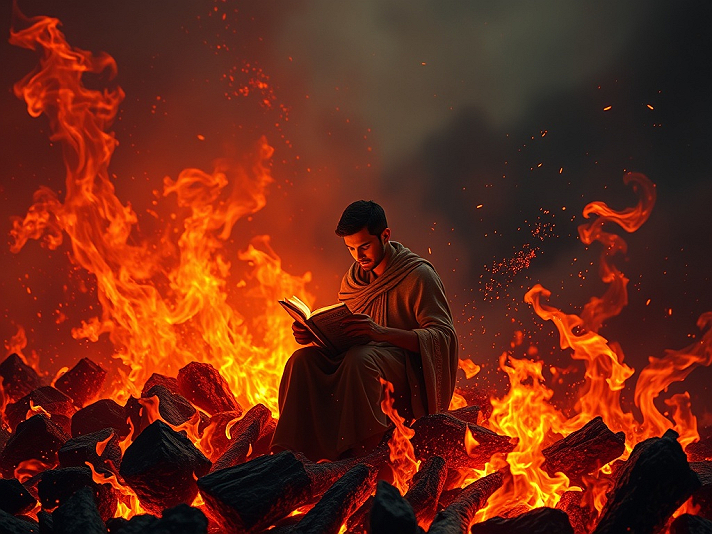
The image is not a scene; it is a verdict. Everything that once pretended to be permanent (steel, concrete, ideology, empire) has already surrendered to the flames. The sky itself has been evicted, replaced by a ceiling of black smoke that drips embers like tears it is too proud to shed. In the middle of this absolute erasure sits one human being, knees drawn up, hood shadowing a face that has forgotten how to flinch. His robe is the color of unbleached sackcloth, the same fabric worn by prophets who announced the fire long before anyone struck the match. The irony is thick enough to choke on: the uniform of mourning has become the only garment fireproof enough for the funeral of the world.
The fire is not content to burn; it is performing. It rears up in serpentine columns, sculpting itself into dragons and angels and falling cities, desperate for an audience that no longer exists. Every tongue of flame is a question: Do you see now? Do you regret now? Will you finally scream? The man answers by turning a page. The motion is so small it should be invisible, yet the entire inferno leans forward to watch. Paper, that fragile conspiracy of wood pulp and rumor, has become the only immovable object in a universe that has specialized in melting. The book is older than the fire, older than the language the fire is trying to erase. Its binding is cracked, its corners dog-eared by centuries of anxious thumbs, but the spine holds the way mountains once held before they learned cowardice.
His posture is the first heresy. In every apocalypse ever filmed, survivors run. They claw at doors, bargain with gods, record tearful goodbyes on dying phones. This man sits. He arranges himself on a throne of coals the way a king might settle into velvet, except the velvet is two thousand degrees and still rising. His bare feet rest on stones that would liquefy diamond, yet the soles remain unmarked. The fire has been tricked into becoming a footstool. Somewhere in the book of Daniel, three young men once walked in a furnace while a fourth figure strolled beside them. History has simply reduced the committee to one, and removed the fourth figure because the man no longer needs a chaperone. He has become the company he keeps.
Look at the light. It is wrong. Fire should illuminate the reader, not the other way around. Yet the glow on his face does not flicker with the flames; it is steady, internal, the way lamplight looks inside a tent on a windy night. The fire is trying to read him by its own brightness and discovering it is illiterate. His eyes move left to right, line after line, absorbing words that were written precisely for this moment, words that predicted the smoke, the smell, the exact temperature of despair. He is not hiding in the book; the book is hiding in him. Every verse he swallows becomes another layer of asbestos around his soul.
The smoke writes and erases simultaneously. For split seconds, phrases appear in the air (Latin, Aramaic, computer code, the private alphabet of childhood diaries), then shred themselves before meaning can settle. The man does not look up. He has already memorized the sentences the smoke is too nervous to finish. One of them, if the flames could hold still long enough, would read: “The fire has been told whom it may not burn.” Another would read: “The story outlives the match.” He knows both by heart, so he lets the smoke keep practicing its cursive in the dark.
His beard is the color of ash that has decided not to fall. The tips are singed, yes, but only the tips, as if the fire kissed him once out of courtesy and then apologized. The rest curls untouched, a dark comma against skin that has forgotten how to blister. Sweat should be pouring, but there is none; the moisture has been drafted into steam long ago, rising to join the smoke’s unfinished sentences. He is the only cool thing left in the world, and the fire hates him for it.
This is what the image actually depicts: the precise instant when destruction discovers it has an expiration date.
The flames have devoured forests older than language, cities that thought their names were eternal, servers that stored every photograph of every child who ever lived. They have turned oceans to steam and mountains to memory. Yet they stall here, baffled by a rectangle of processed tree that refuses to participate in its own cremation. The man is not brave in the cinematic sense; bravery requires the possibility of fear, and fear has already burned away everything it came for. What remains is something quieter and more terrible: certainty. He knows the ending. He has read ahead to the part where the fire itself begs for a drink of water and is given, instead, a new name.
Somewhere in the ashes of what used to be a library, a single page flutters past, still legible: “Though I walk through the valley of the shadow of death, the shadow is the one that gets tired.” The man does not need to read it again. He is living the footnote.
When the fire finally exhausts itself (and it will, because even apocalypse has a fuel gauge), the coals will cool into black glass, and the man will stand up. The book will close with a sound like a judge’s gavel. The smoke will drift away, ashamed. And the first wind of whatever comes next will find him walking out of the furnace carrying the same volume under one arm, pages still warm but unconsumed. He will not look back. There is nothing behind him worth regretting, and nothing ahead that the book has not already spoiled for him in the gentlest possible way.
Until then, he reads.
Line by line.
Word by word.
Refusing to hurry,
refusing to burn,
refusing to let the fire have the last word
when the last word has already been spoken
in a voice too quiet for flames to hear
and too certain for them to forget.