


The Grammar of Standing Water
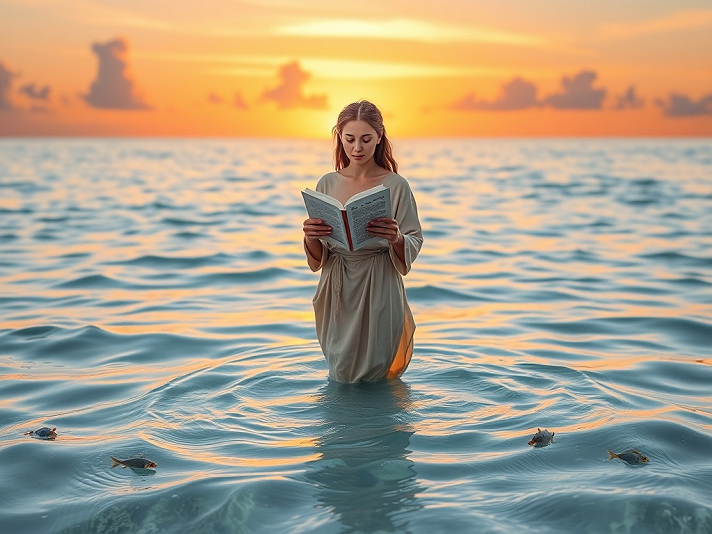
The three photographs, though distinct in setting and light, form a single, slow-moving sentence spoken by water. A young woman stands waist-deep in the sea, always reading, always alone, always unhurried. The book is her constant, the ocean her variable. In the first frame, the water is glassine, the sky a pale, cloudless noon; in the second, jagged rocks rise like broken teeth around her; in the third, the sun bleeds into the horizon and the sea turns molten. Yet the woman’s posture never shifts. Her robe—now pale linen, now the color of wet sand—clings to her legs like a second, obedient tide. The fish that circle her are not decorative; they are punctuation, commas in the long paragraph she is absorbing. The images do not progress; they breathe.
She is not defying gravity. She is negotiating buoyancy. The water should, by every law of displacement, rise to her chest when she lifts the book, but it does not. The pages remain dry, the ink unblurred, as though the sea has agreed to a temporary treaty: you may read, but only if you stand exactly here, only if you do not look up. The robe, heavy with salt, should drag her down, yet it floats in soft folds, a sail that has forgotten wind. Her hair, loosened by the same breeze that ripples the surface, frames her face like seaweed that has learned to behave. The book is thick, its cover the color of terracotta or rust or dried blood, depending on the light. The text is illegible, but her eyes move across it with the patience of tide eroding stone. She is not skimming; she is mining.
In the first image, the shoreline curves behind her like a question mark. The sand is pale, almost white, and the water so clear that her shadow lies on the seabed like a darker twin. Three small fish—gold, then orange, then the color of ember—orbit her knees. They do not dart; they glide, as though the water has thickened into syrup. The mountains in the distance are not majestic; they are exhausted, their peaks softened by millennia of wind. The sky is the color of a shell held to the ear: empty, yet full of rumor. The woman’s expression is not serene; it is absorbed. The difference is in the mouth—slightly open, as if the words on the page have weight and must be tasted before they can be swallowed.
The second image tightens the frame. The rocks crowd in, their surfaces pitted and sharp, as though the sea has been gnawing at them since the first word was spoken. The water here is deeper, the color of jade held to sunlight. The woman stands between two monoliths, the book now held higher, almost at chest level, as if the rocks have demanded tribute. Her robe is drier here, the hem lifted by an unseen current. The fish are gone, replaced by the slow, deliberate shadow of a larger creature moving far below—too far to be seen, close enough to be felt. The sky is bluer, almost violent in its clarity. The woman’s face is tilted downward, but her eyes are not on the page; they are on the space just beyond it, where the words dissolve into water. She is listening to the book the way one listens to a conch: not for the ocean, but for the shape the ocean left behind.
The third image is the exhalation. The sun is half-submerged, the sky a bruise of peach and violet. The water has turned to liquid metal, each wave a hammer strike on an anvil of light. The fish have returned, but they are darker now, their scales catching the last fire of the day. The woman’s robe glows from within, as though the book has kindled something beneath the fabric. Her shadow is long, stretching toward the horizon like a road she will never walk. The book is open to a page that glows—actually glows, the paper translucent, the ink molten. She is not reading anymore; she is being read. The words have entered her bloodstream, and the sea is rising to meet them. The fish circle tighter, their mouths opening and closing in silent applause. The horizon has vanished; there is only the woman, the book, and the water that has agreed to hold her up until the last sentence is finished.
The trilogy is not about solitude. It is about translation. The woman is not escaping the world; she is rendering it legible. Each setting—beach, rocks, open sea—is a different dialect of the same language. The fish are footnotes. The robe is the margin where the text spills over. The book is not a shield; it is a prism. Through it, the sea becomes syntax, the sky punctuation, the sun a period that refuses to end the sentence. The woman’s stillness is not passivity; it is the stillness of a translator who has reached the untranslatable passage and must now invent a new grammar. The water does not wet the pages because the pages are not paper; they are the surface tension of meaning itself.
The images refuse narrative closure. There is no before, no after. There is only the continuous present of reading, the moment when the word and the wave occupy the same space. The woman will not finish the book. The book will finish her. When the last page is turned, the sea will rise to her lips, the fish will enter her mouth like communion wafers, and the robe will unfurl into a sail. She will not drown; she will become the sentence she has been carrying. The horizon will reappear, but it will be inside her. The mountains will speak. The rocks will sing. And the sun, having set, will rise again in the pupil of her eye.
Until then, she stands. The water holds her. The book holds her. The light holds her. And the fish, patient as commas, wait for the next clause.